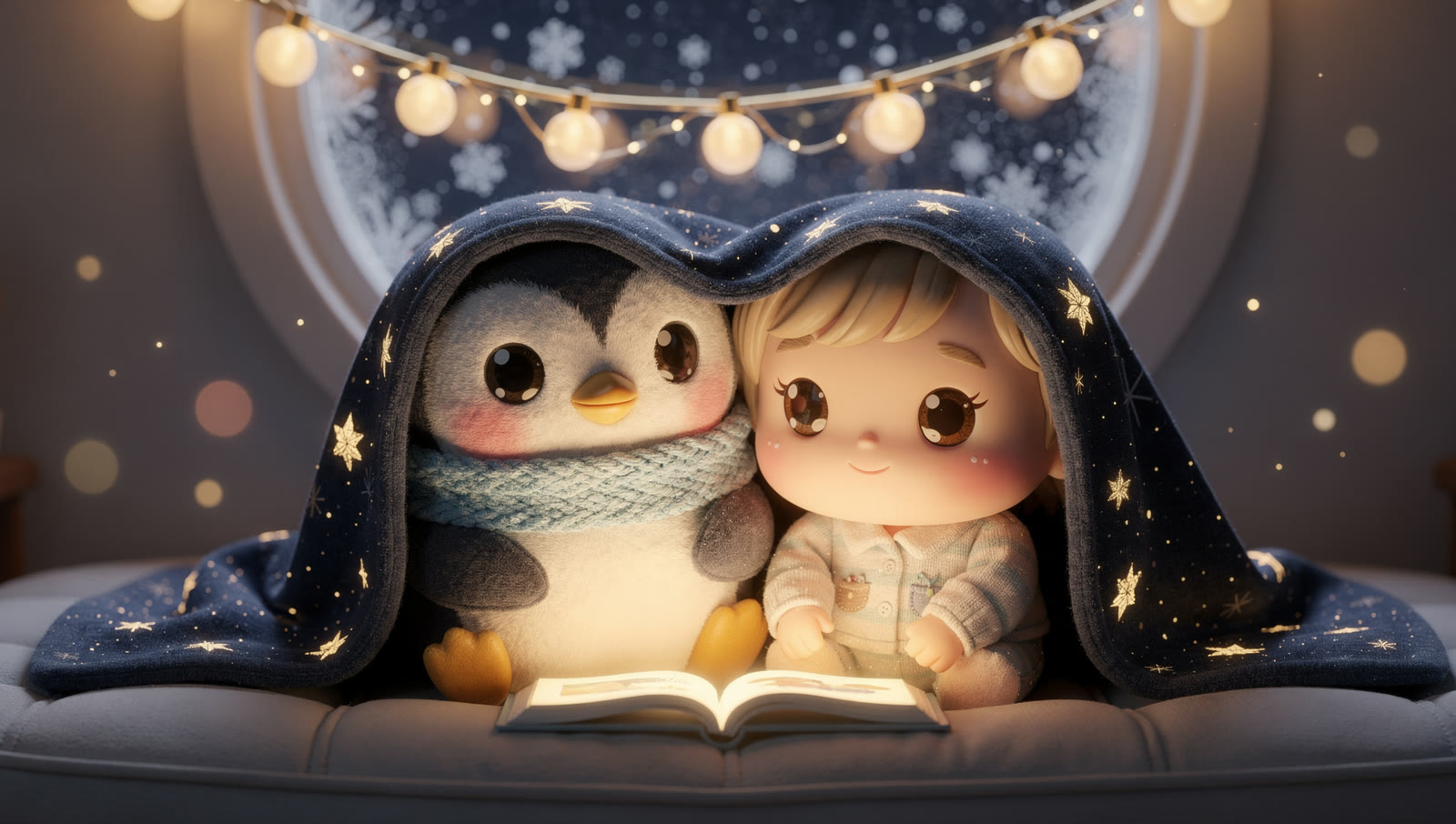
If you're raising a child between two languages — Spanish at abuela's house, English everywhere else, or the other way around — you already know the hardest part isn't teaching words. It's making the minority language feel warm instead of like homework.
Bedtime is quietly the best language moment of the whole day. Here's why, and how to use it.
Why bedtime is prime language time
Language researchers keep circling the same insight: children acquire language best in moments that are emotionally warm, repetitive, and low-pressure. Bedtime is all three by design.
- The brain is relaxed. No performance pressure, no siblings competing, no "say it properly." Words float in alongside safety and cuddles — the exact opposite of a vocabulary drill.
- Repetition is built in. Children demand the same story night after night. That repetition — the same phrases, in the same voice, at the same moment — is precisely how new vocabulary settles in.
- Prosody does half the work. The melody of a language — its rhythm, its softness — is learned by ear. A slow, loving bedtime narration is prosody in its purest form.
"But my Spanish isn't good enough"
This is the most common worry, and the most fixable one. Many parents in bilingual families can't comfortably read aloud in the target language — mixed families, third-generation speakers, adoptive parents keeping a birth culture alive.
The honest answer: you don't have to be the narrator to give your child the language. Your job is the warmth and the ritual; a recording, a grandparent on speakerphone, or a narrated story can carry the pronunciation. Children need to hear rich, correct, loving Spanish at bedtime — they don't audit who produced it.
A real example: Pogo's first snowfall
Here's what this looks like in practice. This is "Pogo el Pingüino y la Primera Nevadita" — a 30-second story generated with Bedtime Stories by Luma, narrated entirely in Spanish:
Pogo el pingüino, con su bufanda azul, adoraba los días soleados. Pero el invierno se acercaba y Pogo tenía un poquito de miedo al frío. Si Pogo no saltaba a la nieve, ¿cómo empezaría la mágica nevada? Con un valiente saltito, ¡Pogo se lanzó! Y ¡puf! Las primeras y suaves estrellitas blancas cayeron. Pogo sonrió, calentito y feliz. ¡La nieve había llegado!
Notice what a good bedtime story in Spanish does: short sentences, gentle repetition of sounds ("saltito… se lanzó"), diminutives everywhere — nevadita, estrellitas, calentito — which is exactly how Spanish-speaking parents actually talk to small children. You can watch Pogo's full animated story in the gallery on our home page.
Stories starring your own child — in Spanish
Luma narrates stories in 11 languages, and Spanish is one of the most loved. The flow is simple: upload one photo (or pick a preset hero like Pogo), choose a theme, pick Español — and the finished 30-second animated video arrives with your child's own name woven into warm Spanish narration.
A few ways bilingual families use it:
- Same story, both languages. Generate the story in English and in Spanish — children adore comparing them, and the parallel exposure is gold.
- The Spanish-only ritual. Make Spanish the official language of bedtime stories. One protected daily slot beats scattered flashcards.
- Grandparent gifts. A story narrated in abuela's language, starring her grandchild, is a gift both generations keep. (More gift ideas in Personalized Gifts for Toddlers.)
Tips that make it stick
- Repeat shamelessly. The same Spanish story for two weeks is a feature, not a rut.
- Pre-teach two or three words, not twenty. "Tonight, listen for bufanda — it means scarf!"
- Keep it inside the routine. Language sticks to ritual. Same time, same blanket, same buenas noches at the end. (Here's how to build that routine.)
- Don't quiz afterward. Let the language be part of the warmth, not a test with a bedtime deadline.
Frequently asked questions
Does my child need to understand every word?
No — and they shouldn't. Comprehension grows from context, pictures, and repetition. A child following Pogo's snowy jump understands saltito long before anyone translates it.
What age should we start?
From birth, honestly — babies absorb prosody before words. For story videos, the sweet spot starts around 18 months, same as any bedtime story format.
We speak zero Spanish at home. Does this still make sense?
Yes, with adjusted expectations: a nightly Spanish story won't make a child fluent alone, but it builds ear, accent, and affection for the language — the foundation everything else stands on.