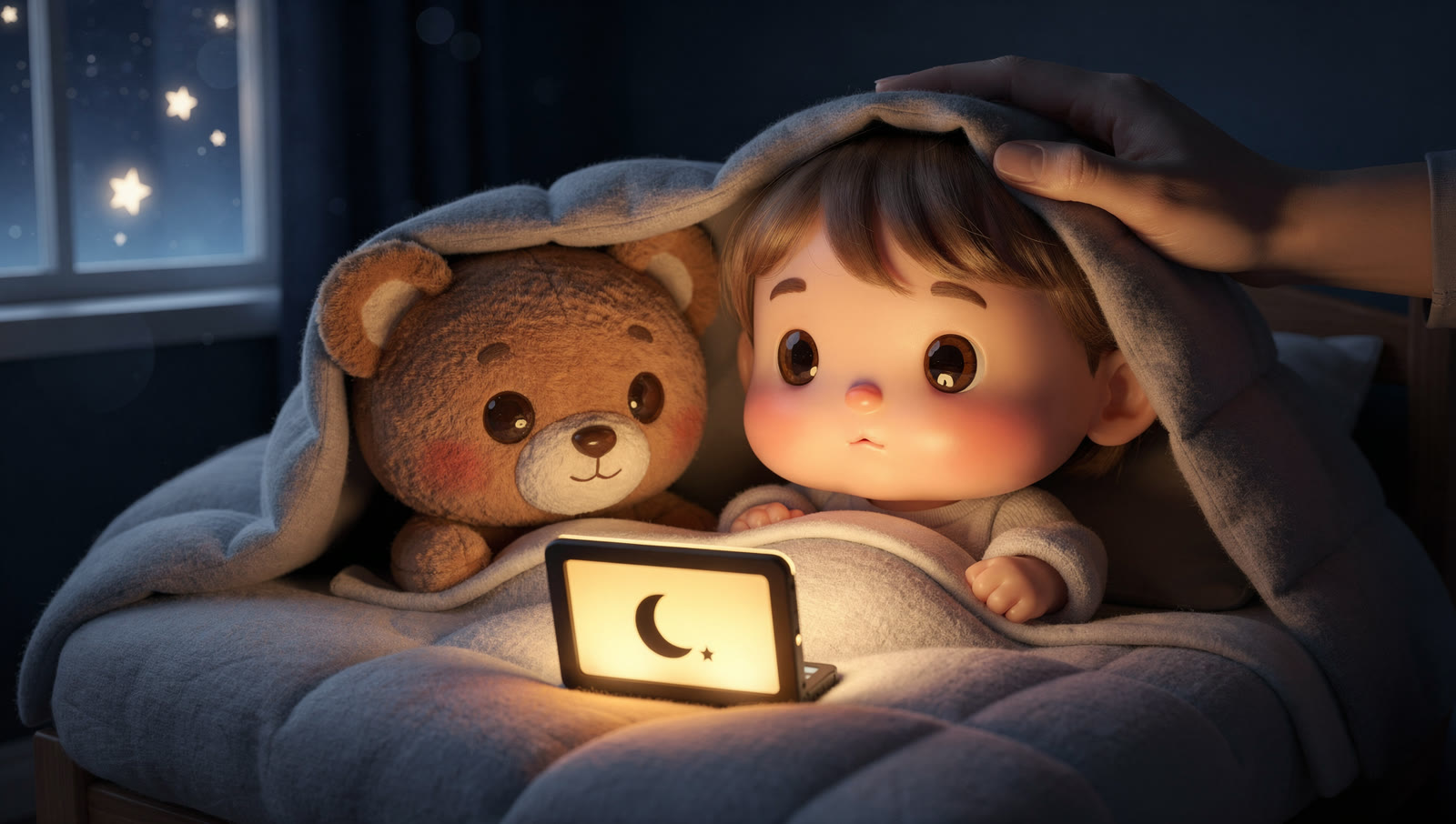
Let's start with the uncomfortable part: we make story videos, and pediatric guidance says to be careful with screens before bed. If we're going to earn a place in your family's evening, we owe you a straight answer about how those two facts fit together.
So here's what the concern actually is, what the research points at, and how to use any screen — including ours — without sabotaging sleep.
What "no screens before bed" is really about
The blanket advice compresses three separate problems into one rule:
- Blue light. Bright, cool-toned light in the evening suppresses melatonin, the hormone that makes us sleepy. Screens held close to a small face deliver plenty of it.
- Stimulation. Fast cuts, loud music, high-arousal content — the modern children's video diet is engineered for maximum engagement, which is the exact opposite of a wind-down.
- The bottomless feed. Autoplay's "next episode" is a negotiation machine. The fight over stopping is often worse for bedtime than the watching itself.
Notice something: only the first problem is about screens as such. The other two are about what plays on them and how it ends. That distinction is the whole game.
Not all screen moments are equal
A useful test for any evening media, ours included:
- Does it end on its own — quickly and definitively?
- Is it calm — slow pacing, soft sound, dim palette?
- Do you watch it together?
- Does it lead somewhere — into the next step of the routine, rather than into "one more"?
Twenty minutes of autoplay cartoons alone in bed fails all four. A three-minute slideshow of family photos with you narrating passes most. The rule of thumb pediatric groups actually converge on is less "zero screens ever" and more: keep the last stretch before lights-out dim, calm, and connected — many recommend winding screens down 30–60 minutes before sleep.
How we designed Luma around exactly this
Knowing all of the above, Bedtime Stories by Luma was built to be the least screen-like screen moment of the day:
- Thirty seconds, then it's over. One story is one video with a definitive, sleepy ending — stars, blankets, goodnight. There is no feed, no autoplay, no "up next." The negotiation machine simply isn't in the product.
- Lullaby pacing by design. Slow drifting camera, no fast cuts, pastel night palette, a music-box melody, a narrator who speaks like a mother reading in the dark. It's engineered downward — toward sleep, not engagement.
- Made for watching together. It's your child on screen; you're both leaning in. That makes it joint attention — closer to reading a picture book together than to handing over a tablet.
- It works without the screen, too. After a few nights, most children know their story by heart. Play just the audio, or retell it yourself with the printed hero card — the story keeps working with the phone face-down.
A realistic evening protocol
If you want the story video and protect sleep, this sequencing works:
- Story video comes early in the routine — after pajamas, before the final dim-down. Not the last thing before lights out.
- Screen at half brightness, night-shift mode on, held at lap distance rather than nose distance.
- Watch once or twice together, then transition with the same phrase every night: "And now, like Pogo, we sleep."
- The last 15–30 minutes before lights out stay screen-free: the goodnight phrase, the dark, your voice.
Used this way, the story is a bridge into the wind-down — the routine's reward, not its rival. (If your routine needs shoring up first, start here.)
The honest bottom line
If your family runs a strict zero-screens-after-dinner policy — keep it. Luma still works for you: the free preview includes the full story text and five illustrations, which make a lovely paper-style bedtime story read in your own voice. The video can live in the morning, or in the photo album, or as the world's best grandparent forward.
For everyone else: a 30-second, self-ending, watched-together lullaby film — placed early in the routine, on a dim screen — is about as sleep-compatible as a screen moment gets. The research concern was never really the glass rectangle. It was what we let it do to the evening.
Frequently asked questions
Is 30 seconds of video really okay before bed?
Placed early in the routine on a dimmed screen, a single fixed-length calm video is a very different exposure from open-ended bright viewing. If sleep is fragile at your house, shift it earlier in the evening and use the audio-only replay at bedtime.
What about the blue light from even 30 seconds?
Dose matters. Half a minute at low brightness with night-shift on is a tiny fraction of the exposure the melatonin studies worry about — but dimming remains a good habit for any evening screen use.
My toddler always demands "again!"
Twice, then the transition phrase, every night the same. The video always ends the same way on its own — after a few nights the ending itself becomes the cue that sleep is next.